As the soil warms and the first green shoots of spring emerge, so do some of the garden’s hungriest inhabitants.
While we often celebrate the return of butterflies, early spring is also the prime time for several moth species and their larvae to begin their feast.
Box Tree Caterpillar (Cydalima perspectalis)
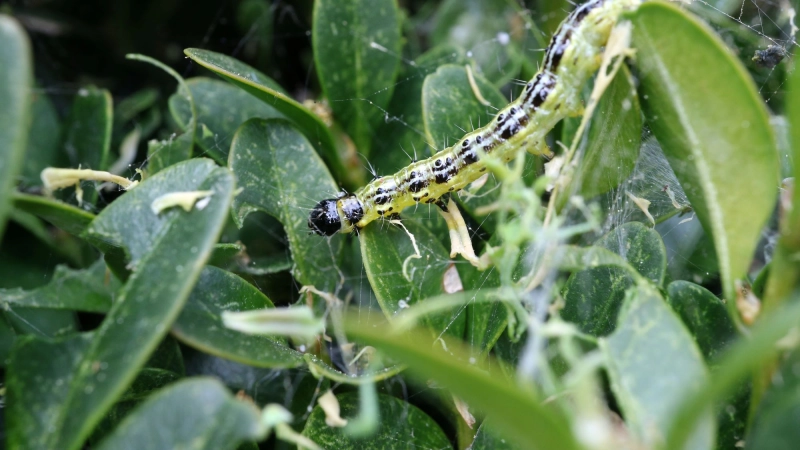
Perhaps the most dreaded guest in modern UK gardens, the box tree caterpillar wakes up from its winter slumber as soon as temperatures are maintained at 8°C to 10°C (usually mid-March).
Read more about these caterpillars in our guide to their lifecycle.
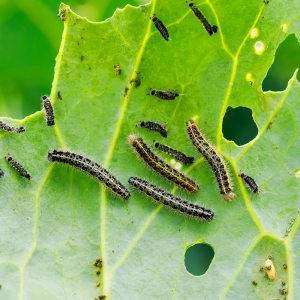
Look for cobweb-like silk webbing within your buxus plants. You’ll find lime-green caterpillars with black stripes and heads. These voracious eaters can strip a box hedge to bare twigs in just a week or two.
Early spring is the time to act but hand-picking is likely to be very difficult due to their ability to hide!
Solution
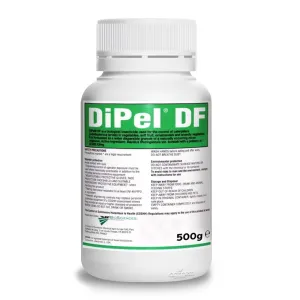
- Dipel DF is a highly effective biological insecticide containing Bacillus thuringiensis var. kurstaki. It’s safe for beneficial insects but lethal to caterpillars once they eat the leaves. Bacillus thuringiensis var. kurstaki is a naturally occurring bacterium. When the caterpillar eats a leaf sprayed with DiPel, the bacteria produce a protein that paralyses their digestive system. They stop eating immediately and die within 2–3 days.
- Use nematodes if the temperatures are above 12°C. These are UK native microscopic worms that actively seek out a variety of caterpillars, feeding and multiplying inside them, then infecting them with a bacterium. Once infected, the caterpillars will stop feeding and die. The nematode will then leave the dead caterpillar and go on to seek out more, repeating the cycle.
- Pheromone traps can be used in summer months.
March Moth (Alsophila aescularia)
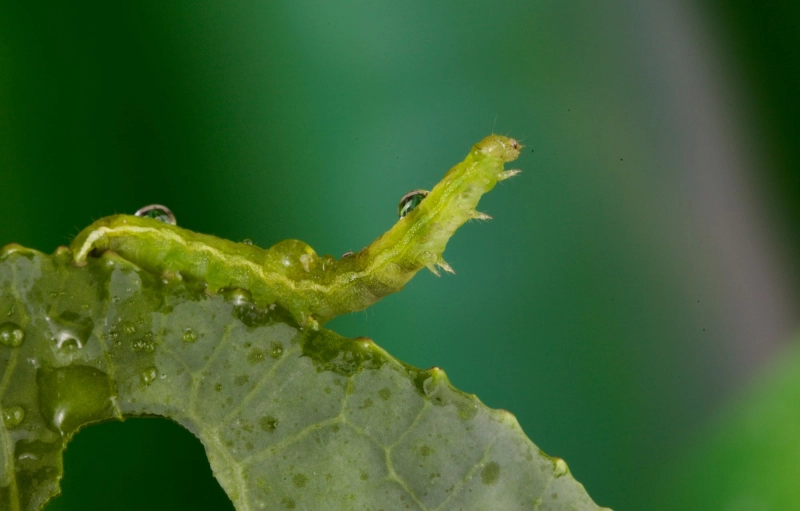
While the adult moths are active in winter, the March moth larvae hatch exactly at bud burst (March and April). The pale green caterpillars are masters of destruction, feeding on hawthorn, oak, apple, pear, plum and other fruit trees.
Look closely and you’ll see tiny green caterpillars spinning silk to bridge between opening leaves. They eat the developing flower buds and young leaves, leading to poor fruit sets and shotholes in the foliage.
Solution
- Pick them off by hand after dark if you can as this is when they are most active - and dispose of them.
- Consider a biological control like Steinernema sp. as described above.
- For larger infestations on ornamental or fruit trees, a targeted spray of Dipel (as described above) can provide rapid control within 2-3 days.
The ‘Woolly Bear’ (Garden Tiger Moth) Arctia caja 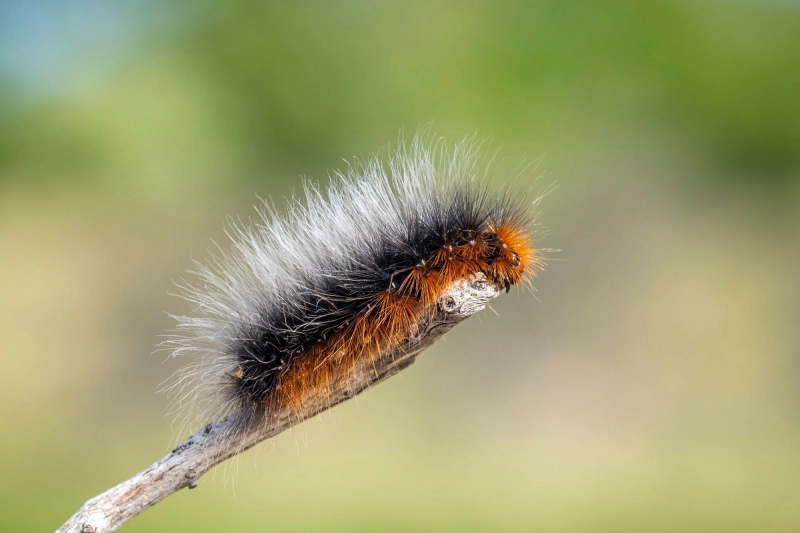
One of our most iconic caterpillars, the Garden Tiger overwinters as a larva and becomes very active in early spring as it searches for food.
They are extremely hairy, black-and-ginger caterpillars (the classic ‘woolly bear’) often seen crossing garden paths or munching on nettles and docks.
Although they tend to cause limited damage in gardens, they can nibble on bedding plants at the same time you might be trying to get them established.
Solution
Usually, these are best removed by hand, but if they are overrunning your nursery stock or young plants, try using nematodes as an environmentally safe way to manage populations.
Oak Processionary Moth (Thaumetopoea processionea)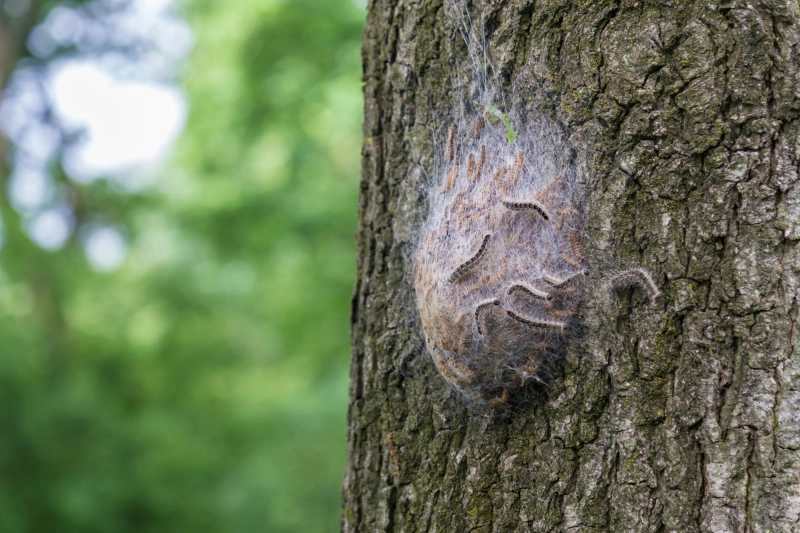
If you have Oak trees, be aware that the Oak Processionary Moth larvae hatch in March or April. These caterpillars represent a serious threat to oak trees.
At the time of writing, Oak Processionary Moths (OPM) are known to be established in most of Greater London and surrounding counties. You are unlikely to encounter them in other parts of the UK.
They are a reportable pest, so if you see these on your oak trees, please submit a report via Tree Alert here.
Note: Do not touch these caterpillars, as their hairs can cause severe skin and respiratory irritation.
Look for tiny orange-brown larvae (initially) that move in nose-to-tail processions. They will cluster together as they feed on the leaves, leaving silk trials on trunks and branches.
OPM caterpillars have been observed feeding on sweet chestnut, hazel, beech, birch and hornbeam, although they tend not to be able to complete their full development on these non-oak species.
Caterpillars have very long white hairs that contrast with shorter hairs, with a grey body and dark head. Older caterpillars can be identified by a dark stripe down their centre with paler lines down each side.
Solution
Dipel DF is our recommended product for treatment of OPM caterpillars. Please get in touch with our technical team if you have any questions regarding the treatment of OPM.
This guide was written in collaboration with Ollie Wright.
Ollie Wright MBPR, FQA
Ollie Wright serves as the Technical Manager at Agrigem, where he oversees the integrity and accuracy of the company’s technical output. A recognised figure within the UK turf-growing sector, Ollie leads Agrigem’s technical response, ensuring that all guidance provided to retail and trade clients remains rigorous, compliant, and at the forefront of industry standards.
With a career built on a foundation of practical experience in farming and landscaping - including the successful management of his own firm - Ollie bridges the gap between theoretical science and field application. His extensive hands-on background is reinforced by industry credentials, including RHS Horticulture, amenity turf and hard surface BASIS, and FACTS qualifications. This unique combination of expertise allows him to deliver high-level strategic advice across diverse sectors regarding plant protection products and complex legislative requirements.
Article Notes:
- DiPel DF Insecticide is a trademark of Sumitomo Chemical UK Ltd. It contains 54 % w/w bacillus thuringiensis kurstaki ABTS-351.
- Use plant protection products safely. Always read the label and product information before use. For label and safety information, refer to the manufacturer’s website.
- Only certified users may apply professional plant protection products. Find out more about safe use of pesticides here.