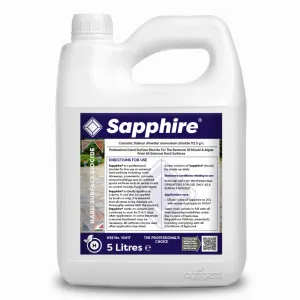
1. It de-greens hard surfaces, dealing with mould, algae and grime quickly
Towards the end of winter or after long periods of cold and wet weather, hard surfaces like patios, fences and roofs quickly green up with algae, mould and grime - making surfaces unsightly and slippery.
Sapphire works quickly to get rid of these grime and algae deposits, returning your hard surfaces to their former glory in as little as two to four days.

2. It’s a professional grade product
Being a professional grade product means it has a different mix and concentration of active ingredients than supermarket alternatives - making it faster and more effective on a wider range of organic deposits.
Despite being a biocide, Sapphire is effective at removing heavy green organic growth often found in shaded areas (commonly referred to as moss cushions). The biggest hurdle in dealing with this type of organic growth is the water-resistant waxy outer layer that initially repels water. Professional grade products like Sapphire include high-end surfactants (wetting agents) that are often excluded from budget retail brands. These wetting agents help Sapphire to penetrate this surface layer and then allow the active ingredients to control it.

3. It’s safe for nearly every type of surface
Sapphire can be used on nearly every type of hard surface, including patios, decking, fencing, brick walls, plastic, concrete, resin driveways, and most roofing materials.
The only note of caution relates to thatch which should be avoided. This is due to Sapphire’s surfactant action as described above, which can alter the waterproof nature of thatch.

4. It uses DDAC
DDAC (or didecyldimethylammonium chloride to give it its proper name) is the primary ‘muscle’ in Sapphire – included at a concentration of 112.5g/L.
DDAC works by disrupting the cell membranes of algae and mould. Essentially, it causes the cellular structure of the organism to leak and collapse at a microscopic level. Unlike bleach, which can damage the surface material, DDAC targets the biological cells, making it safer for the underlying stone, wood, or plastic.

5. It requires no scrubbing or power washing
One of the most appealing aspects of Sapphire is that it requires no scrubbing or pressure washing. Once applied and dried, the active ingredients stay ‘locked’ into the porous surface of the stone or wood.
Over the following two to four days, the mould and algae die. Then, any rain in the following weeks washes away any dead organic matter. This prevents the pitting or damage often caused by high-pressure jet washers and saves you the additional cost and time of power washing.

6. It goes further than other products
Sapphire covers up to four or five times the area of competitor products. This is primarily because it is a highly concentrated product with a 1:40 dilution ratio - significantly higher than other products at 1:4 or 1:9.
The surfactant means the product is more effective at dealing with green deposits, so you don’t have to drench the surface with product to get it to work. This also means it clings to the surface rather than running off, so you use less product overall.
There are several other DDAC-based products on the market, but the same volume of Sapphire goes further than others. To cover a tennis court, you need 20L of MMC (or a similar competitor product) in 200L of water. With Sapphire you need just 5L in 100-200L of water to cover the same tennis court sized area.

7. It has a good environmental and safety profile
Despite being a powerful biocide, Sapphire has some friendly characteristics compared to competitor products.
It is readily biodegradable, meaning the formula is designed to break down into harmless components relatively quickly once it enters the soil or drainage system. It is also pH neutral and does not contain bleach or acids - which is why it is safe for sensitive surfaces like lead flashing, glass, and even artificial sports turf.

8. It is quickly rain fast
Sapphire is rain fast in two to four hours. This means that the active ingredients have worked and are ‘locked in’, gripping onto the algae, grime and mould. Any rain after this point will not wash the active chemical away – unlike many other products that take longer to work. This also helps support its environmental credentials.

9. It does not require heat to work
Heat is often in short supply in winter, so it’s just as well that Sapphire can work well without it.
Some biocides require warmth to activate the ingredients, but this is not the case with Sapphire. This is because the active ingredient DDAC is very stable and does not require heat to work effectively.

10. It prevents mould and algae from reappearing
Because Sapphire continues to work for up to a week after application, it actively prevents algae and mould from regrowing. Unlike bleach, steam or power washing – which only kill what is there at that moment – Sapphire changes the surface environment.
Because the active ingredient (DDAC) is a cationic surfactant, it has a strong positive charge. Most hard surfaces (like stone, brick, or wood) have a slightly negative charge. Like a magnet, the chemical ‘locks’ onto the surface as it dries, rather than evaporating or washing away. Once dry, it leaves behind a thin, durable layer of active chemical. This film is so thin you can’t see or feel it, but it remains toxic to microscopic organisms. When new mould spores or algae cells land on your patio via wind or rain, they immediately meet this residual layer which disrupts their membranes before they can germinate or take root.
Questions about Sapphire? Contact our Tech Team today for free advice.