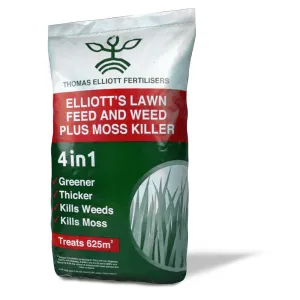
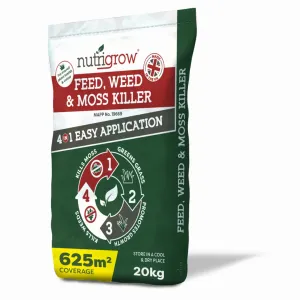
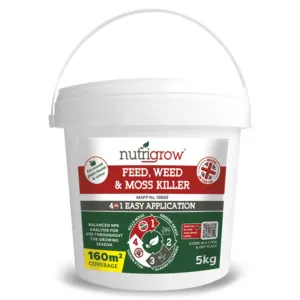
Lawns coping with moss and other weeds can be patchy, stressed and weak, so giving your grass a nutritional boost as you control the moss and weed invaders is a smart move.
Nutrigrow Feed, Weed and Moss Killer contains a range of nutrients:
- 10% nitrogen for robust green growth
- 2% phosphate for strong root development
- 1.7% potassium to promote health and disease resistance
- 8% iron sulphate to encourage green colour and blacken moss
These nutritional contents help your lawn recover and put on lush, dense, and rapidly greener growth - as well as boost its resilience to better withstand disease and extreme weather.
Which Weeds Does it Kill?
Feed, weed, and moss control products from Agrigem will kill a range of lawn weeds (as well as moss), without damaging your grass. It contains a selective herbicide that will kill broadleaved weeds including:
- Dandelion
- Creeping buttercup
- Creeping cinquefoil
- Daisy
- Greater plantain
- Lesser trefoil
- Mouse-ear chickweed
- Ribwort plantain
- Selfheal
- Thyme-leaved speedwell
- White clover
- Birds Foot Trefoil
When to Apply
The general window for applying this product is when the grass is actively growing. This is usually spring and autumn. You can apply Feed, Weed and Moss Killer twice a year.
Spring Application
Feed, Weed and Moss Killer can be applied in spring from March to May as long as there is no frost on the ground and the soil is moist.
Applying it in spring will kill winter moss and any broadleaved weeds that are starting to grow. It will also feed the grass ready for strong thick growth. This growth will help the grass to naturally out-compete weeds.
Autumn Application
Under typical weather conditions, this product can be applied in autumn – from September to October as long as there is no frost, snow or ice on the ground, and the soil is not frozen.
Applying it in autumn will kill any remaining moss – which thrives in winter. Your grass will also benefit from the nutrients, particularly the phosphate to help it develop strong roots for the winter period. Application after August may not be effective as a weed killer.
Whichever season you are applying it in, note that the iron in Feed, Weed and Moss Killer will blacken the moss, so expect to see dark patches where the moss is absorbing the iron. Once all the moss has turned black, you can rake it out, and if necessary overseed.
Timing Rules
- Soil Moisture: The soil should be moist before and during application. If it hasn't rained, water the lawn a day or two beforehand.
- Grass Blades: It is preferable however that the grass blades are dry before applying granular products.
- Temperature: Ideally, apply when the temperature is mild and the grass is actively growing. Do not apply during drought, frost, or scorching hot weather.
- Rain Forecast: Avoid applying if heavy rain is forecast, as it can wash the product away. However, if no rain falls within 48 hours after application, you must water it in thoroughly.
- Mowing: Do not mow for three days before treatment and wait at least four days after treatment before mowing again. This allows the weedkiller to be absorbed by the weed leaves. If you mow before applying, you will remove the weed leaves and the herbicide will be ineffective.
- Turf status: Only apply it to established turf; avoid newly sown grass for the first six months.
How to Apply
Nutrigrow Feed, Weed and Moss Killer is applied at 32g per m2. Measure your lawn area and calculate the exact amount of product you need. Never overdose.
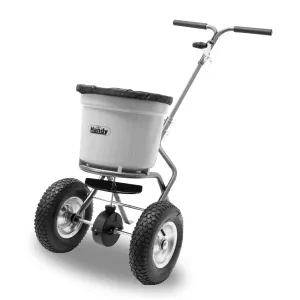
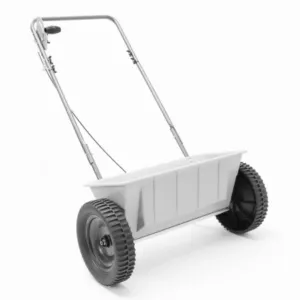
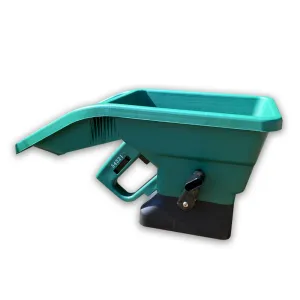
- Use a handheld or push spreader depending on the size of your lawn. For consistent, even coverage, a wheeled spreader is usually best. Follow the product manual to set the spreading rate. If applying by hand, mark out small, measured sections (every 1m for example) and spread the calculated amount evenly over that area first so that you get a feel for the spreading rate.
- Walk in straight, parallel lines at a smooth consistent pace across the entire lawn. Always start walking and then open the spreader’s hopper gate after you have started moving. When you reach the end of each pass, close the gate while you are still moving and before you turn. This prevents fertiliser from dropping in a concentrated pile at the start of each pass and at turning points.
- Some lawncare enthusiasts favour the ‘double pass’ approach. This is where you spread the product at half its intended rate while walking in a vertical lines, then the remaining half at the same 50% spread rate as you walk in horizontal lines perpendicular (at a 90-degree angle) to your first pass. This approach can help ensure a more even coverage and can help avoid ‘striping’ (alternating light and dark green lines) and scorching (where the high concentration of nutrients burns the grass).
- Immediately sweep or brush any granules that land on hard surfaces (patios, paths, driveways) back onto the lawn. The iron content (which kills moss) will cause stubborn brown stains if left wet on paving.
Aftercare
If no rain falls within 48 hours, water the lawn thoroughly to dissolve the granules and activate the feed.
Any moss will typically turn black within seven to 14 days as it dies.
After two weeks, rake out the dead, blackened moss vigorously. This is called scarifying and is essential to remove the thatch and allow new grass to grow.
You can mow the lawn again four days after application.
Questions about Feed, Weed and Moss Killer? Get in touch with our technical team.